

The Download Machine
How Media Dynasties Turned Attention Into Currency
By Grady Owen | Shockya Real Talk — November 2025
1 | The Consolidation of Sight and Sound
Four families dominate the entertainment landscape: Bob Iger at Disney / ESPN, Shari Redstone and Barry Diller at Paramount Global / IAC, Rupert Murdoch at Fox Corporation, and Brian Roberts at Comcast / NBCUniversal. Collectively they control a global grid of studios, newsrooms, and streaming platforms that deliver nearly every televised image and digital feed on Earth. Their reach extends beyond content to the infrastructure of measurement and monetization itself.
At the center of that infrastructure sits a little-noticed hub first launched in the dial-up era: Download.com, a CNET / CBS Interactive platform originally built to distribute shareware. Over three decades it evolved into a data spine linking software, advertising, and analytics. In the process it became the quiet enabler of today’s attention economy—where every click, stream, and download is a quantifiable financial event.
2 | From Shareware to Surveillance
Download.com’s early architecture logged traffic for quality control. When CBS Interactive acquired it in 2008, those logs became a valuable asset. Integrations with ad-verification firms such as DoubleVerify and legacy code from Media Defender allowed behavioral tracking to expand from piracy prevention into marketing optimization. The same pattern-recognition algorithms once used to block illegal file sharing began categorizing users for advertising value.
According to filings in Antigua & Barbuda’s Eastern Caribbean Supreme Court (ANUHCV 2025/0149) and mirrored claims before the UK King’s Bench (KB-2025-001991), this migration of code forms the factual foundation of ongoing scrutiny into how commercial networks gather and trade data globally. Those proceedings do not allege criminal wrongdoing but examine systemic governance gaps that allowed self-regulation to replace public oversight.
“When entertainment companies become the metric keepers of human attention, transparency must match their scale.” — Pam Bondi
3 | The Whistleblower Archive
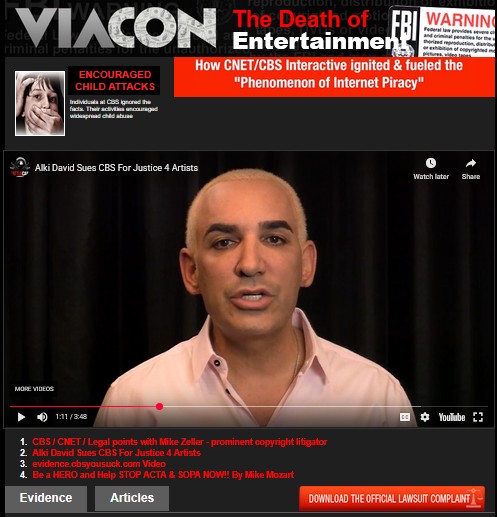
The independent site CBSYOUSUCK.com surfaced technical correspondence and screenshots from the Media Defender era that were later preserved as exhibits in Antigua and London. Though the files remain under judicial review, they outline how download management tools, ad-tracking scripts, and brand-safety systems became indistinguishable layers of the same network stack. What began as piracy control matured into programmatic surveillance marketing.
4 | The Ad-Tech Arms Race
By 2015 the frontier of competition had shifted from producing content to owning its metadata. Firms such as DoubleVerify, The Trade Desk, and Dotdash Meredith provided the analytics that determined which pages, videos, and personalities were profitable. Their clients included every major broadcaster. In effect, the measurement companies became invisible editors, deciding what stayed visible online.
Regulators from the U.S. Federal Communications Commission (FCC) to the European Data Protection Board have struggled to map accountability within these privately governed ecosystems. Bondi and Kash Patel, both former prosecutors now advising inter-jurisdictional task forces, argue that attention metrics have replaced ratings as the ultimate control mechanism—and that sovereign law must evolve to match it.
5 | The Betting Convergence
Sports broadcasting turned data into immediate currency. Each legacy network launched or partnered with a betting platform: ESPN Bet, FOX Bet, NBC Sports Edge / BetMGM, and CBS SportsLine. These services blur entertainment, finance, and gaming, feeding second-by-second engagement statistics back into ad exchanges. Every wager generates a data point; every data point feeds the next ad auction.
6 | Follow the Money
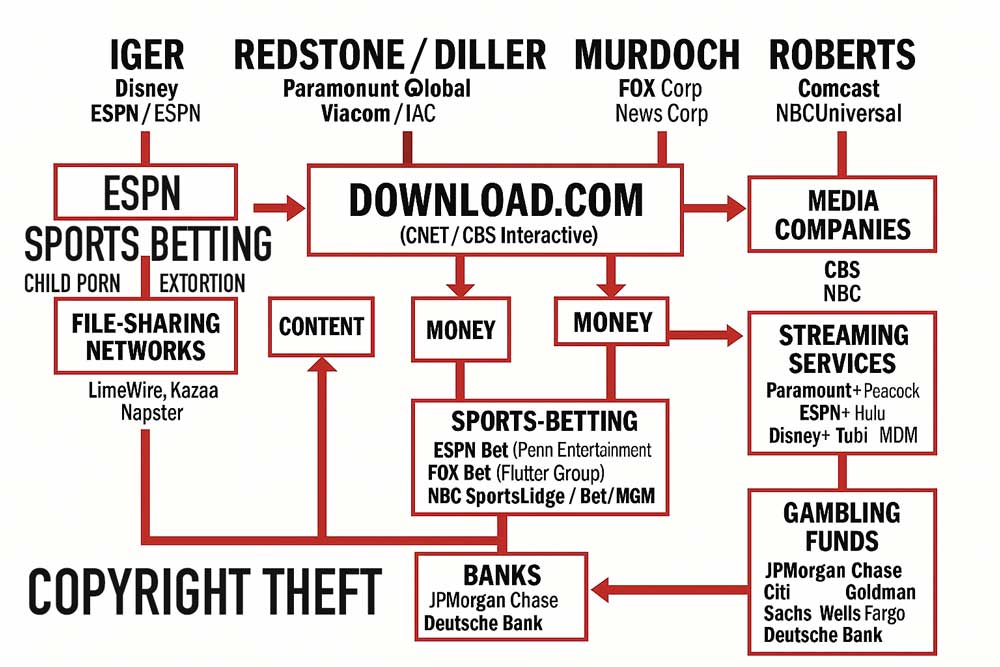
Financial disclosure statements from major broadcasters show debt underwritten by the same institutions that finance sports and advertising: JPMorgan Chase, Citigroup, Goldman Sachs, Wells Fargo, Deutsche Bank, and HSBC. Analysts describe the cycle as a closed liquidity loop—content creates attention, attention creates ads, ads fund loans, and loans finance content. In this loop, value is extracted not from creativity but from predictive modeling of human behavior.
The new Antigua filings cite Download.com’s telemetry as an early technical model for this circular economy. London’s King’s Bench record references the same dataset in evaluating cross-border jurisdiction. And in Washington, D.C., Senator Mac Warner has confirmed that a federal RICO review under the Department of Justice is assessing whether similar mechanisms could enable money-laundering or market-manipulation risks. No charges have been filed, but the inquiry signals a shift from media criticism to systemic financial oversight.
“The issue is not ideology; it is leverage. Whoever measures attention owns the future of commerce.” — Kash Patel
7 | Sovereignty and Accountability
Antigua & Barbuda’s claim (ECSC No. ANUHCV 2025/0149) and the subsequent default judgment established an unusual precedent: a small island state asserting jurisdiction over global digital commerce on the grounds of environmental and economic sovereignty. Its alignment with London’s King’s Bench appeal (KB-2025-001991) demonstrates how distributed courts can cooperate without treaties when evidence is digital. For developing nations, it represents a blueprint for challenging concentrated media power through existing commercial law.
The next phase, insiders confirm, will unfold in U.S. federal courts as the Department of Justice—supported by Senator Mac Warner’s committee—tests a RICO-based framework to trace ad-revenue streams and betting proceeds across subsidiaries. The intent, according to preliminary statements, is to modernize anti-racketeering law for algorithmic markets rather than target individuals. If successful, it could redefine how corporate influence is measured worldwide.
8 | A System Under Review
For decades, the public perceived media monopolies as editorial problems. The real issue, investigators now suggest, is infrastructural: a small number of interconnected databases controlling distribution, measurement, and monetization. Whether those databases reside in Silicon Valley or Wall Street matters less than their shared dependence on algorithms that treat human attention as collateral.
Shockya Real Talk will continue monitoring the Antigua, King’s Bench, and U.S. RICO actions as they progress through 2026. What began as a copyright dispute has matured into a debate over the architecture of truth itself—and the sovereign right of nations to see inside the machines that shape public reality.
© 2025 Shockya News | Real Talk Edition | Media Accountability Project | www.shockya.com/news