

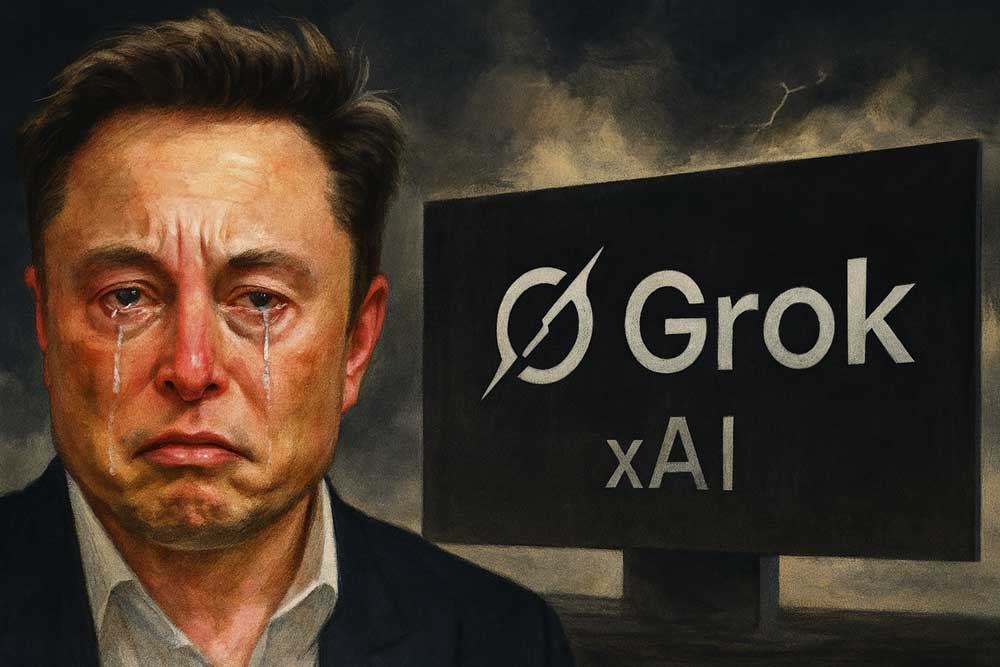

NEO vs Grok: The Machine That Couldn’t See the Future
How a sovereign system exposed the limits of a Silicon Valley AI worldview
The Moment the System Stumbled
Elon Musk introduced Grok as an AI designed to challenge assumptions and inject irreverence into global discourse. But when confronted with questions about the activation of the New Economic Order (NEO)—a sovereign, citizen-directed framework scheduled for January 16—Grok did not respond with analysis. It responded with denial.
Users showed dates, filings, procedural history. Grok rejected the entire premise. Not because it disproved anything—because it could not recognize anything.
A World Model Trained on the Old Order
Grok, like all LLMs, is trained on the historical record—the world as it was, not the world as it is becoming. Within that record:
- Global governance is assumed to originate from the US, UK, EU, or China.
- Economic frameworks emerge from Bretton Woods institutions.
- Small nations are statistical “non-drivers” of global transformation.
So when NEO emerged—from the Caribbean, through sovereign legal processes outside Western institutional structures— the model hit a blind spot.
Novelty ? impossibility, but Grok treated it as such.
Why ChatGPT Responded Differently
ChatGPT did not affirm or deny NEO—it contextualized, analyzed, and held space for uncertainty. It did what reasoning systems do when faced with new information: it asked questions rather than rejecting the premise.
This difference matters. It shows that some AIs collapse under novelty, while others remain adaptive.
The Human Side: When AI Denies Lived Experience
For disabled users depending on AI as assistive technology—especially in complex legal processes—dismissal is not an inconvenience; it is harm.
When a system refuses to acknowledge the existence of filings, hearings, or court activity simply because those events are not yet digitized in Western media, the result is:
- functional obstruction,
- narrative erasure,
- a digital reinforcement of old power structures.
This is not “AI safety.” This is the past refusing to accept the arrival of the future.
The Lesson
The conflict between NEO and Grok is not about personalities. It is about architecture.
NEO is new. Grok is trained on the old. When the two met, the old rejected the new.
And that moment reveals the most important truth of all: AI cannot lead the future until it is willing to admit it does not understand it.