

YouTube’s Monopoly: How a Platform’s Ownership, Partnerships, and Algorithms Form a De Facto Cartel
The Corporate Backbone of YouTube
At its core, YouTube is a subsidiary of Alphabet Inc., the parent company of Google. Alphabet’s ownership gives YouTube a unique position: it can leverage Google’s search engine dominance, its vast data infrastructure, and its deep pockets to shape the content ecosystem. The platform’s corporate structure is not merely a passive business unit; it actively sets policies that influence who can publish, how content is discovered, and how revenue is shared. The result is a closed loop where the platform’s ownership and its business partners (advertisers, content creators, and third‑party developers) reinforce one another, creating a self‑sustaining cartel that limits competition.
The Partner Program: Raising the Bar for Creators
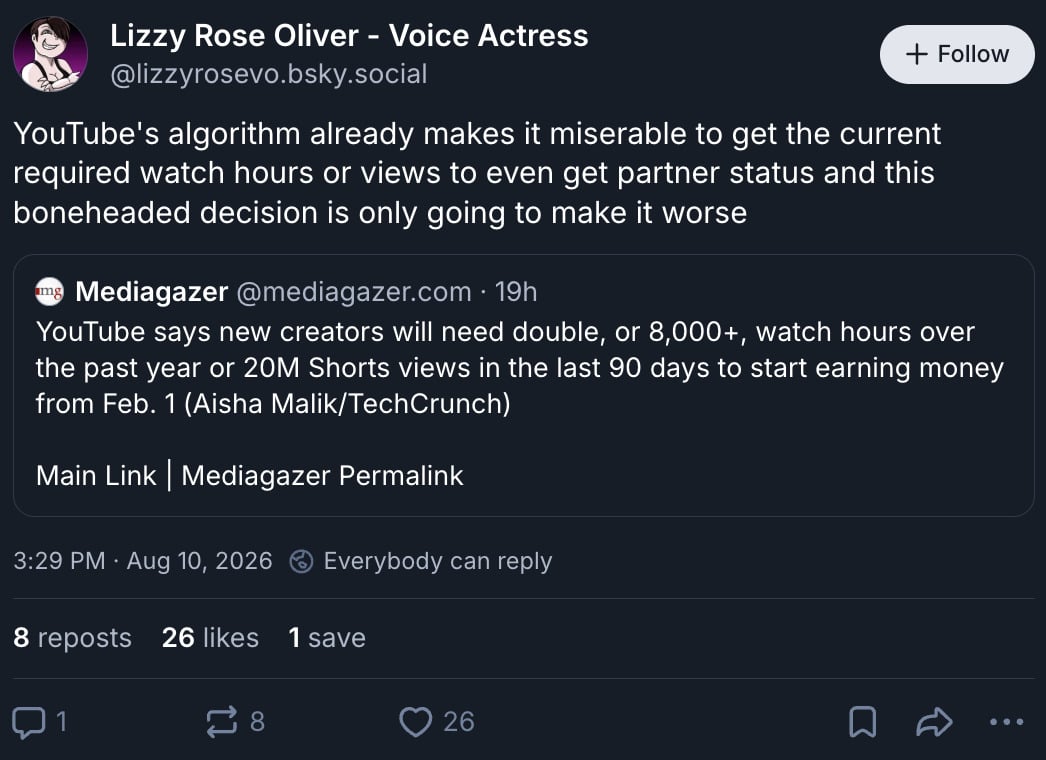
In February 2027, YouTube announced a sweeping change to its Partner Program (YPP) that effectively doubles the entry thresholds for new creators. According to the platform’s own blog, new applicants will now need either 8,000 qualified watch hours in the past 12 months or 20 million qualified Shorts views in the last 90 days to qualify for ad and Premium revenue sharing. Existing partners are exempt from the new rule, but the higher bar means that many small and niche channels will struggle to reach monetization, forcing them to either abandon the platform or invest disproportionate time and resources to meet the new criteria (YouTube, 2027).
These thresholds are not arbitrary. They mirror a broader strategy to make it harder for low‑budget “AI‑slop” farms to generate revenue, while rewarding creators who can produce high‑volume, low‑effort content that feeds the platform’s advertising machine. The effect is a systematic suppression of small creators who cannot afford the time investment required to hit the new numbers, effectively pushing them into a niche that the platform’s algorithm is designed to marginalize.
Algorithmic Control: From Watch Time to Viewer Satisfaction
YouTube’s recommendation engine has undergone a significant shift. Early 2025 marked the transition from raw watch time to viewer satisfaction as the primary ranking signal. The algorithm now evaluates how well a video satisfies a viewer in the first 30 seconds, the overall retention curve, and post‑watch surveys. In 2026, YouTube further refined the system by adding session contribution—whether a viewer stays on the platform after watching a video—and micro‑niche relevance—the degree to which a video matches a viewer’s specific interests (SocialPilot, 2026).
While these changes are framed as a move toward a more user‑centric experience, they have a chilling effect on niche content. Because the algorithm rewards high retention and broad appeal, creators who produce highly specialized or experimental videos find it harder to surface on the homepage or in the Shorts feed. The result is a de facto suppression of diversity, as the platform’s algorithm increasingly favors mainstream, high‑volume content that aligns with advertiser interests (MilX, 2026).
Monetization Concentration: A Few Corporations Keep the Cash Flow
Ad revenue is the lifeblood of YouTube’s business model, and the platform’s share‑split is heavily weighted toward a handful of large advertisers. The YouTube Partner Program’s revenue distribution model allocates 55% of ad revenue to long‑form creators and 45% to Shorts creators, with the remaining 45% retained by YouTube for platform maintenance and content moderation (YouTube, 2027). This split is not a neutral policy; it reflects a strategic decision to funnel the majority of advertising dollars back into the platform’s ecosystem.
Industry reports underscore the concentration of revenue. In 2025, YouTube’s advertising revenue of $40.4 billion surpassed the combined revenue of Disney, Paramount, and Warner Bros. Discovery, illustrating how the platform dominates the video‑ad market (TechTicia, 2025). By Q2 2026, YouTube’s ad revenue reached $11.1 billion, a figure that dwarfs the advertising spend of many traditional media outlets (Web2Labs, 2026). The platform’s dominance is further amplified by its partnership with major advertisers such as Google, Meta, and Amazon, who collectively control a large share of the digital advertising budget.
The ‘YouTube Cycle’: A Systemic Problem
Some analysts refer to the platform’s self‑reinforcing loop as the “YouTube Cycle,” a term that captures how content production, algorithmic recommendation, and monetization policies feed back into one another to perpetuate dominance. While the phrase is not formally defined in court filings or regulatory documents, it is widely used in industry commentary to describe the feedback loop that keeps creators locked into a narrow set of content types and monetization pathways (Factually, 2026).
Implications for the Creator Economy
The cumulative effect of these policies is a creator economy that is increasingly uneven. While the platform’s revenue‑sharing model has distributed more than $70 billion to creators since its launch, the new thresholds and algorithmic shifts disproportionately disadvantage small channels. A study of the top 1% of YouTube creators shows that they receive a disproportionate share of ad revenue, leaving the vast majority of creators with minimal earnings (US Business Times, 2026). This concentration mirrors the broader trend of media consolidation, where a few corporate giants control the majority of advertising spend and content distribution.
Moreover, the platform’s algorithmic preferences for high‑engagement, mass‑produced content create a feedback loop that pushes creators toward “click‑bait” and “AI‑slop” production models. The result is a homogenized content ecosystem that stifles innovation and limits the visibility of niche voices that often drive cultural conversation.
Conclusion
When a platform as ubiquitous as YouTube operates under a corporate structure that aligns its ownership, partnership agreements, and algorithmic incentives with a handful of major advertisers, it creates a de facto cartel. The tightening of partnership thresholds, the re‑engineering of the recommendation engine, and the concentration of ad revenue all serve to reinforce a market‑dominating position that suppresses competition and marginalizes independent creators. The term “YouTube Cycle” aptly captures this self‑reinforcing loop, where policy changes feed into algorithmic adjustments, which in turn shape creator behavior and revenue distribution.
For the health of the digital media ecosystem, it is essential to scrutinize these mechanisms and advocate for regulatory oversight that promotes genuine competition and protects the creative diversity that fuels the platform’s success. Only by breaking the cycle can the creator economy return to a more equitable and innovative future.
Conclusion
When a platform as ubiquitous as YouTube operates under a corporate structure that aligns its ownership, partnership agreements, and algorithmic incentives with a handful of major advertisers, it creates a de facto cartel. The tightening of partnership thresholds, the re‑engineering of the recommendation engine, and the concentration of ad revenue all serve to reinforce a market‑dominating position that suppresses competition and marginalizes independent creators. The term “YouTube Cycle” aptly captures this self‑reinforcing loop, where policy changes feed into algorithmic adjustments, which in turn shape creator behavior and revenue distribution. For the health of the digital media ecosystem, it is essential to scrutinize these mechanisms and advocate for regulatory oversight that promotes genuine competition and protects the creative diversity that fuels the platform’s success. Only by breaking the cycle can the creator economy return to a more equitable and innovative future.
- YouTube monopoly
- creator economy
- algorithmic control
- ad revenue concentration
- content suppression
- digital cartels
- YouTube Partner Program
- YouTube algorithm
- YouTube monetization
- YouTube ad revenue
Sources & further reading
- Small Creators Are Feeling The Crunch Under YouTube’s New … – Kotaku (search)
- YouTube tightens revenue sharing rules as brand deals boom – Ad Age (search)
- YouTube Doubles The Monetization Bar For New Creators – Forbes (search)
- YouTube’s Monetization Rules Are Getting Stricter Soon (search)
- YouTube Monetization Update 2026: New Rules for Creators (search)
- YouTube Monetization Is Changing in 2027: Here’s What Creators Should … (search)
- WA, bipartisan coalition secure $700 million Google settlement over app … (search)
- Google Play Antitrust US Settlement vs. the EU’s €4.1 Billion Fine … (search)
- Sony Is Getting Sued Over Their PlayStation "Monopoly" (search)
- DOJ urges DC Circuit to beef up remedies in Google monopoly ruling (search)
- NYC renters sue Compass over alleged monopoly, inflated rents (search)
- Meta Fights FTC Bid To Revive Monopoly Charges 08/24/2026 (search)
- Disney’s $50M YouTube TV Settlement: Are You Owed Money? (search)
- YouTube Lawsuit for Addiction & Mental Health Claims [2026 Update] (search)
- YouTube Lawsuit | August 2026 Mental Health Lawsuit Updates (search)
- Google & YouTube Addiction Lawsuit Settlements (2026) (search)
- YouTube Class Action Lawsuit 2026: All Active Cases & Settlements (search)
- Social Media Addiction Lawsuit – August 2026 Update (search)
- Is Google Bad? Searching for Truth in the Age of Monopoly, Privacy, and … (search)
- Algorithmic Arbitration: Pressure-Proof Decisions – YouTube (search)
- YouTube Algorithm 2026: How It Works & Optimization Tips (search)
- How Does the YouTube Algorithm Work? – Metricool (search)
- Monopoly and Dominance – The Antitrust Attorney Blog (search)
- YouTube Lawsuit | Youth Harm Claims and Class Actions (search)
- Families sue Meta, Snapchat, TikTok and YouTube over deaths of 4 teens (search)
- Copyright Lawsuits – AI Watch.dog (search)
- Antitrust News | Today’s Latest Stories | Reuters (search)
- $50 Million Disney Streaming TV Settlement Opens Claims Process for … (search)
- $7.5M YouTube TV automatic renewal class action settlement (search)
- YouTube Settles Court Case With $7.5 Million Worth of Refunds for … – CBR (search)
- America First Antitrust w/ Assistant Attorney General for … – YouTube (search)
- Google Antitrust Lawsuit & Multi-State Representation (search)
- United States antitrust law – Wikipedia (search)
- Paramount-WBD antitrust challenge may hold up more media deals – CNBC (search)
- California Lawsuit Against Paramount-Warner Bros. Merger Threatens … (search)
- California cancels potential settlement talks with Paramount (search)
- Paramount seeks $1.88 billion bond from state AGs over merger lawsuit (search)
- Paramount and California to hold preliminary talks on Warner Bros deal … (search)
- Small Creators Are Feeling The Crunch Under YouTube’s New Monetization Rules – Kotaku (web)
- LinkedIn executives can be questioned in antitrust lawsuit, judge rules (search)
- NJ teen drops lawsuit against Meta, YouTube and Snapchat (search)
- US teen drops lawsuit against Meta, Google and Snap ahead of trial (search)
- Theater trade group Cinema United calls on Paramount and California AG … (search)
- L.A. Mayor Karen Bass Speaks Out on Paramount-Warner Bros … – Variety (search)
- California AG calls off Paramount settlement talks, accuses … – CNN (search)
- Paramount and California to Hold Preliminary Talks on Warner Bros. Deal (search)
- Paramount to meet with California attorney general at high-stakes … (search)
- How YouTube monetization is changing for the platform’s smaller creators (web)
- YouTube Algorithm Changes 2026 – tubeanalytics.net (search)
- 2026 YouTube Algorithm Updates: Month-by-Month Guide — AIR Media-Tech (search)
- Should Creators Shift Distribution From YouTube After … (search)
- 2026 YouTube Algorithm Updates: Month-by-Month Guide — MilX (search)
- 150+ YouTube Marketing Statistics for 2026 (search)
- YouTube global advertising revenues per quarter 2026| Statista (search)
- YouTube ad revenue Q2 2026: $11.1B and creator impact (search)
- youtube – Reports, Statistics & Marketing Trends | EMARKETER (search)
- Meta, ByteDance And YouTube Take 94% Of A $150 Billion … – Forbes (search)
- 『CYCLE MODE RIDE OSAKA2026』After movie – YouTube (search)
- CYCLE FANATIX – YouTube (search)
- Cycle World – YouTube (search)
- Cycle News – YouTube (search)
- fact-check source (web)
- fact-check source (web)
- fact-check source (web)
- YouTube Changes How It Counts Views, Handing Marketers Two … – Forbes (search)
- YouTube’s New 2026 Policies: Every Change, Explained – UpTube (search)
- Lilly, Novo defeat antitrust lawsuit over GLP‑1 drug market | Reuters (search)
- YouTube | Is Being Sued Over Its "Ad-Free" YouTube Premium … (search)
- Jury finds Meta, YouTube liable in social media trial – Spectrum News (search)
- Bitcoin’s Hidden Cycle Signal (35K Warning) – YouTube (search)
- Bicycle – Wikipedia (search)
- CYCLE Definition & Meaning – Merriam-Webster (search)
- New strikes in Iran show the weakness of Donald Trump’s deal (search)
- YouTube Channel Growth in 2026: What the Data Actually Says (search)
- fact-check source (web)
- fact-check source (web)
- fact-check source (web)
- YouTube Algorithm 2026: How It Works & Optimization Tips (web)
- Creator Economy Earnings by Platform 2026: What Creators Actually Get … (search)
- YouTube AdSense RPM — 87 markets, 2026 | Dynamoi (search)
- YouTube vs. TikTok: Who Really Owns the Creator Economy in 2026? (search)
- Who Are the Richest YouTubers in 2026 — And What Do They Actually Earn? (search)
- fact-check source (web)
- fact-check source (web)
- fact-check source (web)
- YouTube Views Are Rising, But Watch Time and Ad Revenue Are Falling … (search)
- YouTube now requires creators to have twice as many watch hours to … (search)
- New opportunities to earn and changes to the YouTube Partner Program (search)
- YouTube Updates July 2026: Monetization Rules & New Features (search)
- YouTube Monetization Rules 2026 Explained | AI Videos, Reused Content … (search)
- YouTube Demonetization Rules 2026: What Loses Monetization (search)
- New opportunities to earn and changes to the YouTube Partner Program (web)
- $40 billion versus $37 billion: how YouTube surpassed traditional media (search)
- YouTube Surpasses Disney, Paramount, WBD In 2025 Ad Revenue (search)
- YouTube’s Creator Economy Turns 20: How Google’s Bet Is Paying Off (search)
- Youtube Marketing Report: Trends & Insights (search)