

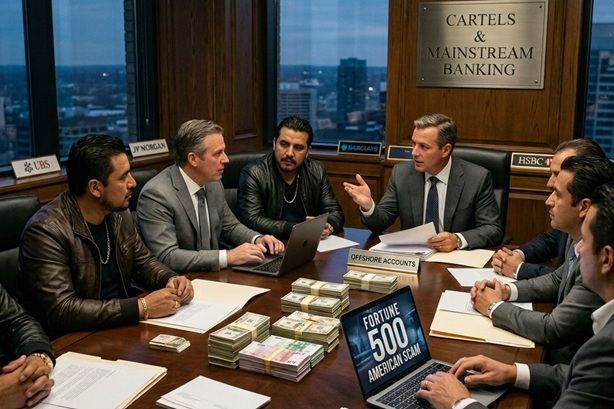
Too Big to Fail, Too Powerful to Convict: The Systemic Risks of Regulatory Capture in U.S. Banking
Introduction
For more than a decade, the United States has been the global hub for the conversion of illicit cash into legitimate dollars. While the law imposes strict anti‑money‑laundering (AML) obligations on every financial institution, the enforcement record shows a stark asymmetry: street couriers are prosecuted, but the Fortune 500 banks that process the bulk of the traffic rarely face criminal liability. This article explores how regulatory capture—defined as the industry’s ability to shape rules and enforcement in its favor—creates a systemic risk that threatens the stability of the dollar system itself.
Cartel Money‑Laundering Pathways
Drug cartels generate physical U.S. dollars in American cities, but those dollars are useless in their home markets until they are placed, layered, and integrated into the local economy. The classic Latin American method is the Black Market Peso Exchange (BMPE), where U.S. cash is sold to a broker, then purchased by a Mexican or Colombian importer who pays a U.S. exporter for goods. The importer, in turn, pays the cartel in pesos. The transaction appears as a legitimate trade payment, masking the illicit origin.
In 2025, FinCEN documented a newer overlay: Chinese money‑laundering networks buy U.S. cash from cartels and mirror a peso credit back to the cartel in Mexico, eliminating the need for cross‑border movement of physical cash. Both methods rely on a bank that can clear large dollar wires—typically a U.S. correspondent account held by a Fortune 500 institution.
Key Enforcement Cases
Wachovia / Wells Fargo (2010)
Wachovia admitted failure to monitor over $420 billion in transactions with Mexican casas de cambio, including $110 million in proven narcotics proceeds. The penalty was a $160 million fine and deferred prosecution; no senior bankers were jailed.
HSBC (2012)
HSBC Bank USA laundered at least $881 million for Sinaloa and Norte del Valle. HSBC Mexico shipped $7 billion in physical dollars to the U.S. affiliate in 2007‑08, a volume that authorities linked to drug cash. The settlement was $1.92 billion, a five‑year monitor, and deferred prosecution, with no executive indictments.
Citigroup’s Banamex USA (2017)
Banamex processed $8.8 billion in remittances to Mexico, opening fewer than 10 investigations on $142 million in alerts. The institution paid $97.4 million in forfeiture under a non‑prosecution agreement.
TD Bank (2024)
TD Bank’s 92% of transaction volume from 2018‑2024—about $18.3 trillion—remained unmonitored. Three networks moved $670 million through the bank, including $470 million tied to fentanyl. The bank pleaded guilty to conspiracy to launder money, the first U.S. national bank to do so, and faced roughly $3 billion in penalties.
2025 Treasury Actions
FinCEN cut three Mexican firms—CIBanco, Intercam, and Vector Casa de Bolsa—out of dollar rails, labeling them primary money‑laundering concerns. These actions demonstrate that when a firm is not systemically load‑bearing, the Treasury can sever its access; when it is, the Treasury opts for a deferred‑prosecution agreement.
Regulatory Capture Mechanisms
Regulatory capture in U.S. banking manifests in four interlocking layers:
- Lobbying and revolving doors – Banks spend millions on lobbying; each additional year reduces the odds of a severe supervisory action by 11.4% (Lambert, 2019). Former regulators often join banks’ government‑relations teams.
- Deferred‑Prosecution Agreements (DPAs) – The standard enforcement tool: a fine, a monitor, and a promise not to prosecute. DPAs treat banks as infrastructure rather than criminals.
- Media framing – Scandals are reported as “compliance failures” with CEO apologies, not as criminal conspiracies. The narrative ends when a monitor certifies progress.
- Legal doctrine – The 1999 Holder “collateral consequences” memo explicitly states that prosecuting a bank could threaten systemic stability; this doctrine has been invoked in the HSBC case.
Empirical Evidence of Capture
Studies confirm that lobbying correlates with weaker AML rules and enforcement. The IMF literature review notes that bank lobbying is associated with lower regulatory stringency. FinCEN’s 2020 SAR leak showed banks filing suspicious activity reports on more than $2 trillion they already believed suspicious, yet the median lag between transaction and SAR filing was 166 days—far too slow to prevent money flow.
Five of the banks in the leak—JPMorgan, HSBC, Standard Chartered, Deutsche Bank, and BNY Mellon—had already faced AML fines and continued processing illicit funds, illustrating recidivism under a legal‑department shield.
Media Pathway and Public Perception
When a Fortune 500 bank is implicated, the coverage follows a predictable pattern: a leak or Senate hearing, a fine announcement, a CEO apology, a monitor appointment, and a business‑section story that frames the event as a compliance issue. In contrast, a street courier’s arrest is highlighted with the cartel’s name, the sentence, and the narrative of criminal justice. The asymmetry in personhood—bank as a “system” versus individual as a “criminal”—creates a perception that the law treats the same illicit activity differently based on the actor’s size.
Policy Recommendations
- Reclassify DPAs as criminal sanctions – Treat deferred‑prosecution agreements as a form of criminal liability, subject to the same penalties and potential criminal charges for executives.
- Strengthen SAR thresholds and reporting speed – Mandate real‑time SAR filing for transactions above a lower threshold, and impose civil penalties for delays exceeding 48 hours.
- Limit lobbying influence – Enact a cap on lobbying expenditures for banks and require full disclosure of all former regulators in senior compliance roles.
- Independent oversight of correspondent banking – Create a statutory body that monitors correspondent accounts for high‑risk jurisdictions, with the power to suspend access without a DPA.
- Public transparency and whistleblower incentives – Require banks to publish anonymized SAR volumes and outcomes; expand whistleblower protections for AML staff.
Conclusion
Large U.S. banks have long served as the arteries through which cartel cash flows into the global economy. The pattern of fines, deferred prosecutions, and continued licensing demonstrates a systemic capture that prioritizes financial stability over criminal accountability. By reclassifying DPAs, tightening SAR reporting, curbing lobbying, and instituting independent oversight, regulators can restore the rule of law to the dollar system and mitigate the systemic risk posed by unchecked money‑laundering networks.
- regulatory capture
- anti‑money‑laundering
- U.S. banking
- cartel money laundering
- systemic risk
- financial regulation
- banking reform
- FinCEN
- HSBC
- Wachovia
- TD Bank
- Citigroup
- JPMorgan
Sources & further reading
- FinCEN Files – ICIJ (search)
- U.S. Treasury Department files implicate banks in money laundering … (search)
- Mexico U S banking interconnection and AML – Funds Society (search)
- Citi, Mellon Cut Ties with Intercam after US Accusations (search)
- Money laundering news & latest pictures from latintimes.com (search)