

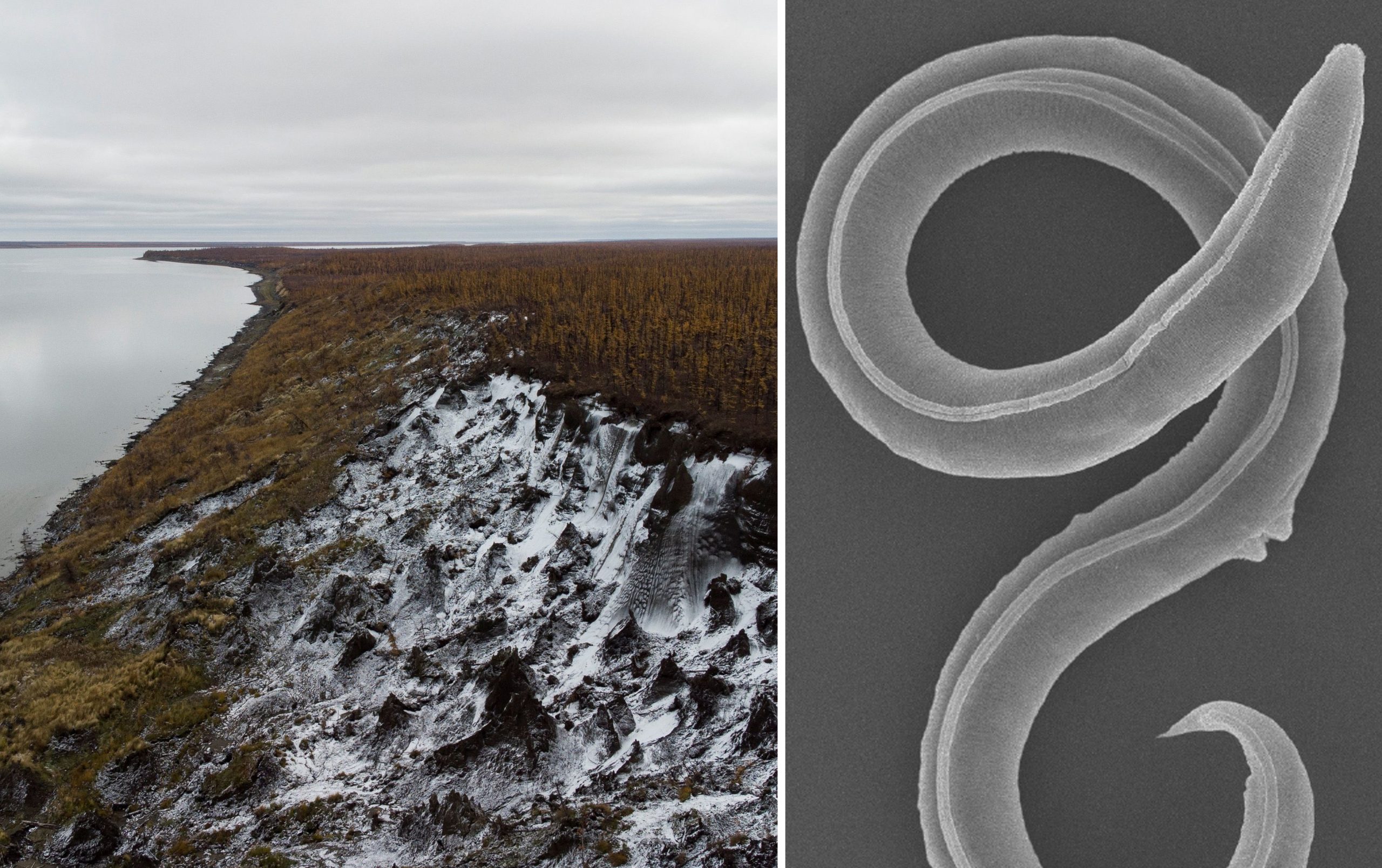
In a groundbreaking study that brings to mind scenes from Jurassic Park, scientists have achieved an incredible feat – waking up tiny creatures that have been in slumber for a staggering 46,000 years. These remarkable beings, known as nematodes, were discovered in the frozen permafrost along the northern Kolyma River in Siberia.
The researchers’ incredible journey began when they stumbled upon these microscopic animals, seemingly trapped in time within the icy confines of the permafrost. After a thorough radiocarbon analysis, the startling revelation came to light – these nematodes originated from a bygone era, coexisting with ancient creatures like Neanderthals and dire wolves, during a time long lost to history.
Even more astonishing is the revelation that these nematodes belong to a species previously unknown to the scientific community. Termed Panagrolaimus kolymaensis, this species was once considered functionally extinct. However, the nematodes’ successful revival challenges that notion, sparking new hope for reawakening other long-dormant life forms hidden within the earth’s icy embrace.
This groundbreaking discovery opens up a treasure trove of possibilities for scientific research. Nematodes, despite their minuscule size, play crucial roles in various ecosystems. Their revival not only sheds light on the Earth’s past but also has implications for understanding how life can withstand the test of time in extreme conditions.
The researchers’ work raises intriguing questions about the possibilities of resurrecting other ancient life forms and even offers a glimpse into potential future applications. Understanding how these creatures survived millennia of suspended animation could have implications for fields like cryogenics and space travel, where preserving life in a dormant state is a fascinating challenge.
The preservation of life in permafrost is no longer just a topic for science fiction; it’s a tangible reality with tremendous implications. As the climate crisis continues to unfold, uncovering and studying these ancient beings may provide essential insights into how life responds and adapts to significant changes in its environment.
The study of Panagrolaimus kolymaensis and its resurrection serves as a poignant reminder of the delicate balance of life on our planet. It’s a testament to the resilience and adaptability of living organisms, offering valuable lessons for preserving and protecting biodiversity in the face of modern-day challenges.
In conclusion, this extraordinary scientific discovery has thrust nematodes from the shadowy depths of prehistory into the limelight of modern-day research. The revival of these 46,000-year-old creatures, once believed lost to the annals of time, opens doors to new frontiers of scientific exploration and deepens our understanding of life’s tenacity. As scientists continue their pursuit of knowledge, one can only wonder what other secrets lie buried in the frozen archives of our planet.