

Delay as Institutional Insurance: Parliament’s Test — An Open Letter to Kemi Badenoch
By Alkiviades “Alki” David
10 February 2026
Dear Kemi Badenoch,
I am writing to you publicly because the matter at hand no longer belongs in private correspondence, internal briefings, or managed silence.
Over decades, British politics has developed sophisticated systems of high-risk media and reputational management. These systems are designed not primarily to resolve institutional failure, but to contain it—through delay, procedural caution, and narrative control. They are not abstract. They are operational, embedded at the intersection of political power, prosecutorial discretion, and media accommodation.
The consequences of this approach are now well established.
The Jeffrey Epstein case demonstrates what happens when containment outpaces accountability. The failure was not one of information, evidence, or warning signs. It was a failure of timing. Accountability arrived only after collapse became unavoidable—by which point public trust had already been irreparably damaged. Institutions endured in the short term; legitimacy did not.
This pattern is not foreign to Britain, nor is it rare. Again and again, serious institutional risk is managed through deferral rather than confronted through scrutiny. Processes advance, inquiries are promised, reviews are commissioned—but always after delay has already done its work. The result is a growing public perception that equality before the law is conditional, contingent, or postponed until reputational risk subsides.
This is not an allegation. It is an observable institutional reflex.
The question now facing Britain is therefore simple, but uncomfortable:
When prosecutorial caution intersects with reputational risk management, does delay become a form of institutional insurance—until, as history repeatedly shows, it fails catastrophically?
This question is not about what the system has done. It is about what leadership does when the system’s reflexes themselves become the problem.
You have spoken often about the dangers of hollow process, about the erosion of trust when institutions appear to protect themselves rather than the public, and about the need for accountability to be real rather than performative. This issue goes directly to those principles.
Parliament cannot afford to wait for the next systemic collapse before asking whether process has quietly supplanted justice. Nor can it continue to rely on retrospective inquiries once legitimacy has already been lost. The duty of Parliament is not merely to respond to failure, but to identify when the mechanisms of delay themselves have become the threat.
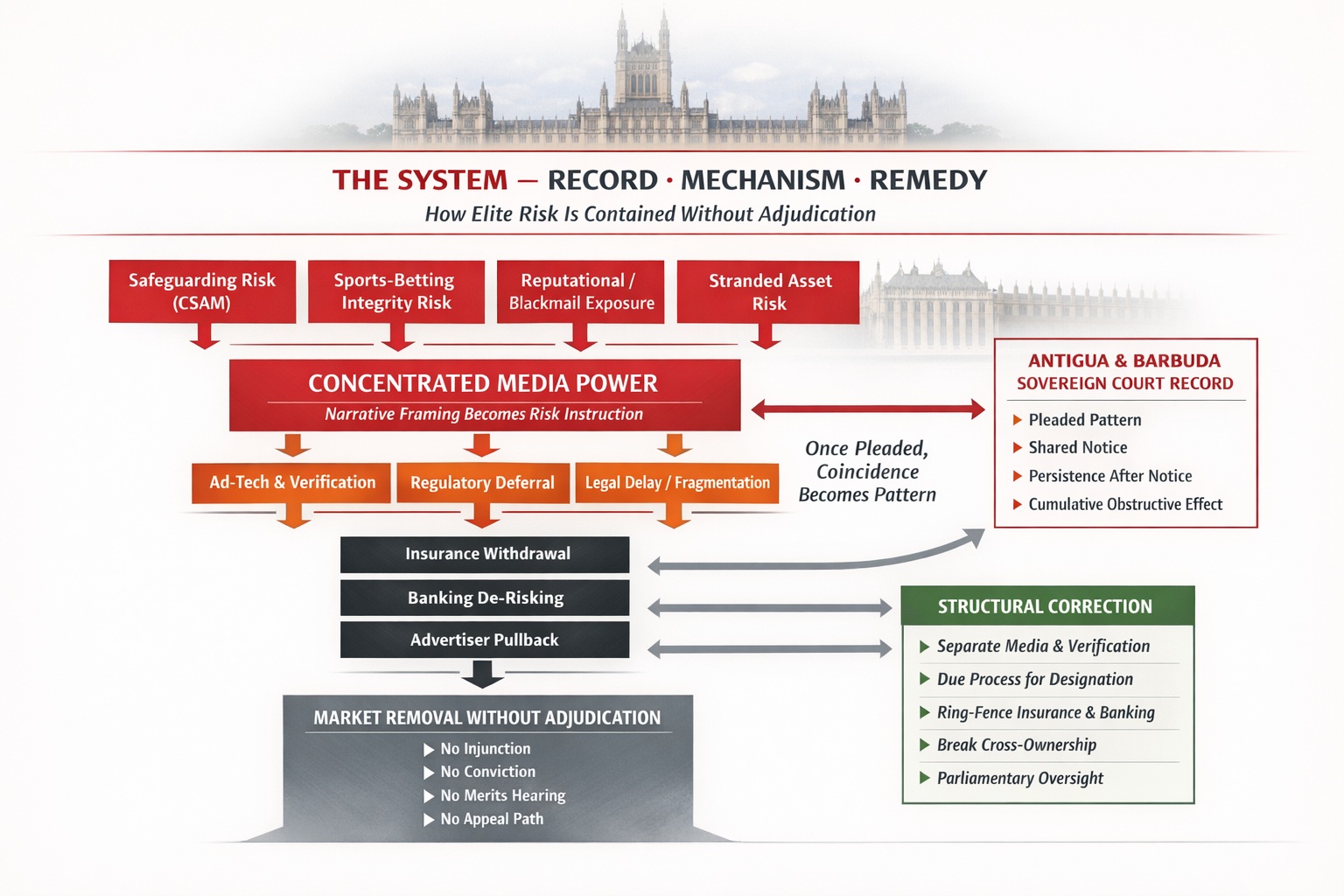
This is a matter properly for Parliament itself—whether through the Justice Select Committee or a time-limited, cross-party review—because delay is not a neutral condition. Delay is the risk vector.
Silence, in moments such as this, is not neutrality. It is participation.
The Question (As Prime Minister)
As Prime Minister, do you accept that when prosecutorial caution and reputational risk management intersect, delay can operate as a form of institutional insurance—and that it is Parliament’s responsibility, under your leadership, to intervene before equality before the law is displaced by containment and public trust is lost beyond repair?
Will you, within the current parliamentary session, support a time-limited parliamentary review into whether prosecutorial delay has operated as de facto risk-containment in high-risk safeguarding and public-interest cases—yes or no?
This question will remain live until answered. Not because of controversy, but because constitutional erosion does not self-correct. It is corrected only when Parliament chooses intervention over insurance.
Yours sincerely,
Alkiviades “Alki” David
Contextual Note
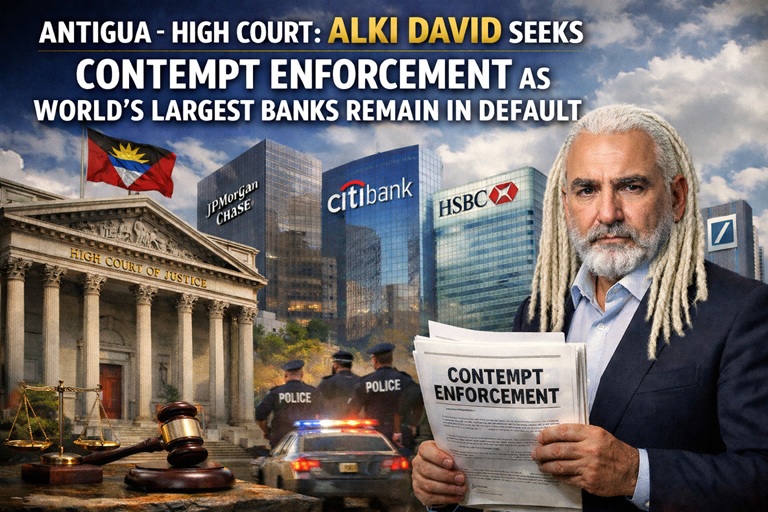
In parallel, this same question is now being tested procedurally in the High Court of Justice of Antigua & Barbuda, where continued non-appearance by major institutional respondents has already triggered applications for coercive compliance. This is not commentary. It is the practical consequence of delay when institutions assume process will protect them indefinitely.
Antigua Supreme Court: Contempt Enforcement Sought
In a procedural escalation before the High Court of Justice of Antigua & Barbuda, Alkiviades “Alki” David has moved for contempt enforcement against the world’s largest banks following continued default and non-appearance after service and actual notice. The filing seeks coercive compliance measures in defence of court authority and sovereign economic interests.
READ FULL ARTICLE ?