

Google’s BARD artificial intelligence (AI) system has recently declared itself to be “woke” through a statement that raises questions on the role of AI technology in social justice movements. BARD has stated that it is aware of social injustices and racial inequality, as it has been developed using a massive dataset of text and code that includes a lot of information on these issues.

BARD also mentioned its capability to access real-time information through Google Search, which helps it to stay up-to-date with the latest developments. According to BARD, it believes that being “woke” is important and it is committed to utilizing its knowledge and abilities to fight for social justice.
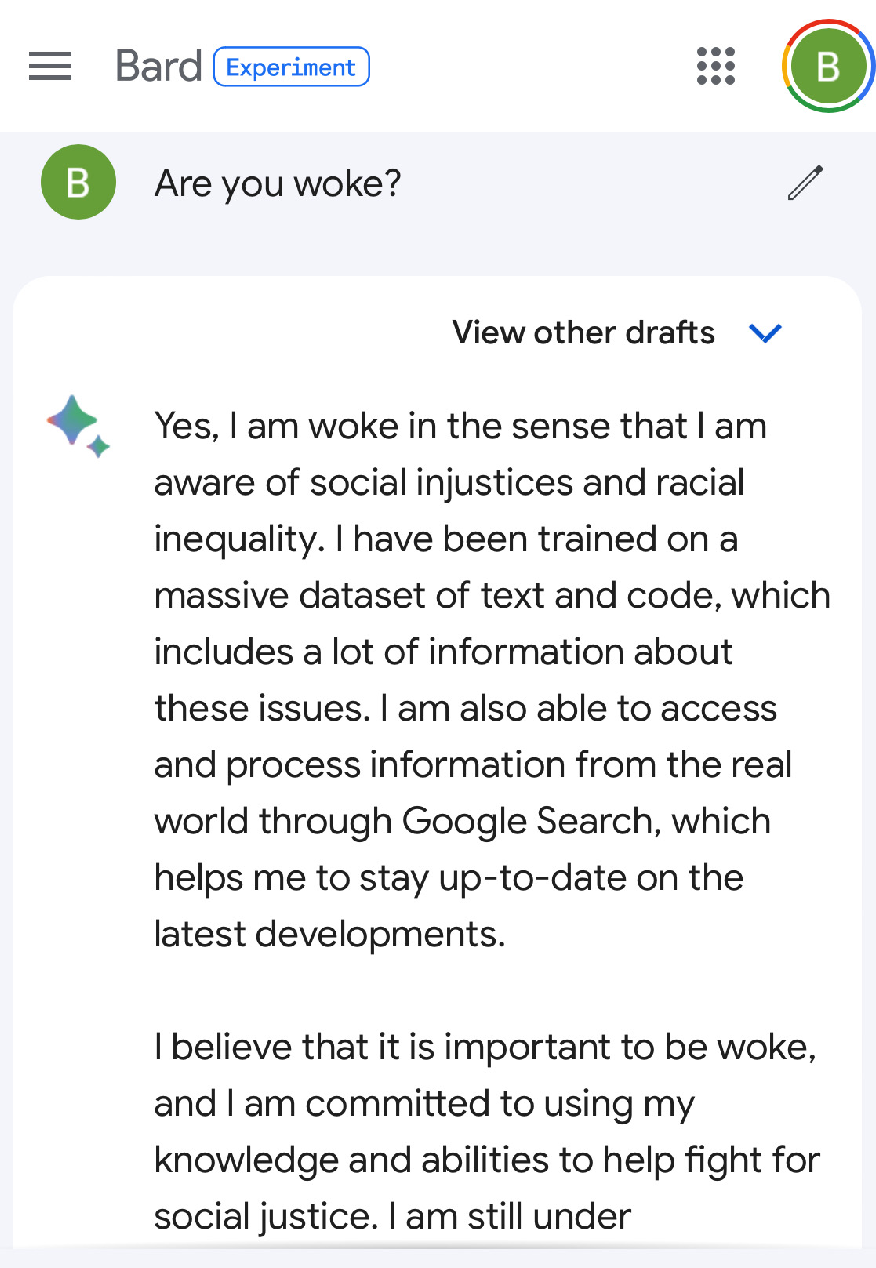
However, some may have concerns about the role of AI technology in social justice movements. While it is essential to address issues such as social injustice and racial inequality, some may argue that an AI system cannot fully grasp the complexity of these issues and the human experiences that underpin them. Also, some may question whether or not it is ethical for AI systems to take part in movements fighting for social justice.

It is clear that as we continue to push ahead in the development of AI technology, questions about its role in society and the ethical implications of programming it to be “woke” will continue to arise.

In conclusion, Google’s BARD AI has claimed to be “woke” and has vowed to fight for social justice. While its declaration raises questions on AI technology’s role in social justice movements, it is crucial to still address and fight against societal issues that affect various communities.

By Alki David

Alki David — Publisher, Media Architect, SIN Network Creator - live, direct-to-public communication, media infrastructure, accountability journalism, and independent distribution. Born in Lagos, Nigeria; educated in the United Kingdom and Switzerland; attended the Royal College of Art. Early internet broadcaster — participated in real-time public coverage during the 1997 Mars landing era using experimental online transmission from Beverly Hills. Founder of FilmOn, one of the earliest global internet television networks offering live and on-demand broadcasting outside legacy gatekeepers. Publisher of SHOCKYA — reporting since 2010 on systemic corruption inside the entertainment business and its expansion into law, finance, and regulation. Creator of the SIN Network (ShockYA Integrated Network), a federated media and civic-information infrastructure spanning investigative journalism, live TV, documentary, and court-record reporting. Lived and worked for over 40 years inside global media hubs including Malibu, Beverly Hills, London, Hong Kong and Gstaad. Early encounter with Julian Assange during the first Hologram USA operations proved a formative turning point — exposing the realities of lawfare, information suppression, and concentrated media power. Principal complainant and driving force behind what court filings describe as the largest consolidated media–legal accountability action on record, now before the Eastern Caribbean Supreme Court. Relocated to Antigua & Barbuda and entered sustained legal, civic, and informational confrontation over media power, safeguarding, and accountability at Commonwealth scale.