

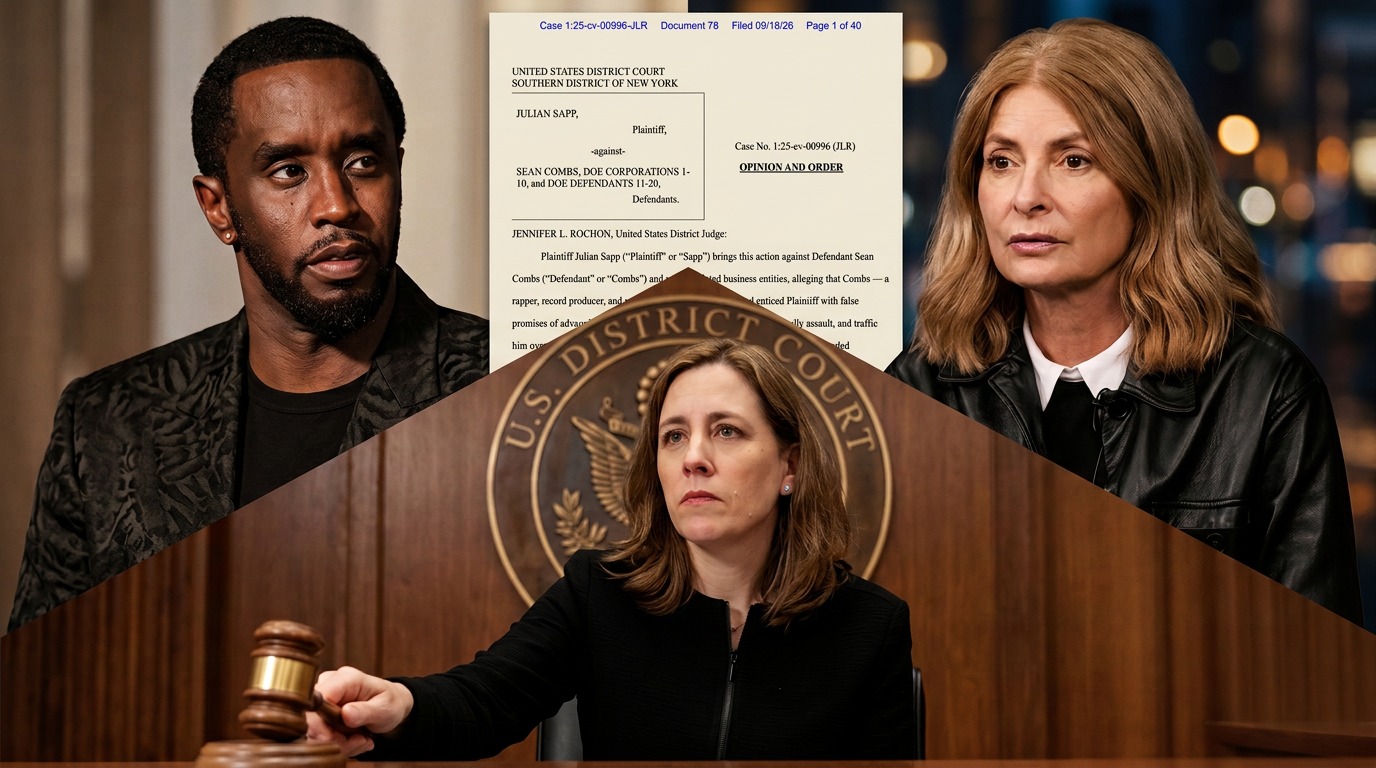
NEW YORK — A federal judge has dismissed a lawsuit accusing Sean Combs of drugging, sexually assaulting and threatening a Las Vegas entertainer over five years. She ruled that nearly every claim was filed too late, and that the complaint offered no facts showing the plaintiff tried to act sooner.
U.S. District Judge Jennifer L. Rochon granted Combs’ motion to dismiss on Sept. 18 in a 40-page opinion. She assumed the allegations were true, as courts must at that stage, and did not rule on whether the alleged abuse occurred.
The plaintiff, Julian Sapp, alleged the conduct ran from 2007 to November 2012. He sued on Feb. 4, 2025.
An AI analysis of the filings found that the amended complaint, drafted by Lisa Bloom and her law firm, The Bloom Firm after defense motions had already raised the timing problem, added detail about the alleged threats. It added nothing about what Sapp did during the intervening decade. The judge identified that omission as an independent ground for dismissal.
It is the second Combs lawsuit brought by The Bloom Firm to be dismissed on timeliness grounds in three months. On June 12, U.S. District Judge Katherine Polk Failla dismissed claims by former Danity Kane singer Dawn Richard as time-barred, rejected her tolling arguments and declined jurisdiction over her New York City gender-violence claim. Rochon cited that ruling repeatedly, quoting its finding that over 12 to 13 years the defendants’ “power and control over Plaintiff dissipated such that she was not diligent in pursuing her rights.”
The Allegations
According to the amended complaint, Sapp was working as an adult entertainer when an agency booked him to perform for Combs at a Las Vegas hotel in 2007. After several bookings, Combs asked him to work for him directly and offered to help his music career, the complaint said.
Sapp alleged that meetings in Las Vegas, New York, Los Angeles and Miami repeatedly turned to coerced sexual activity. He alleged Combs gave him drinks, marijuana and baby oil that left him incapacitated. He also alleged that Combs displayed firearms, took his phone and blocked doors with furniture, and forced him into sex acts with men and women who were present.
Sapp alleged that on more than one occasion, including in New York and Los Angeles, he awoke with physical signs that led him to believe he had been raped.
The complaint said Combs told Sapp he had secretly recorded him and would release the tapes. It also said Combs made statements including “I make people disappear.”
Combs was convicted in a separate federal criminal case of transportation to engage in prostitution, according to the amended complaint.
The Ruling
Sapp’s two federal claims, for forced labor and sex trafficking, carry a 10-year limitations period. Rochon found that period expired around November 2022, more than two years before he sued.
To proceed, Sapp needed equitable tolling. That doctrine requires a plaintiff to show that an extraordinary circumstance prevented timely filing and that he pursued his rights diligently.
On the first element, Rochon distinguished a 2023 appeals court decision, Doe v. United States. In that case an immigration officer’s threats against an undocumented woman were held potentially sufficient. The judge said that defendant held governmental power over the victim’s immigration status, while Sapp’s own account showed he resisted Combs and ended contact by 2012.
“The Court does not minimize the gravity of the conduct Sapp alleges,” Rochon wrote.
On diligence, the judge wrote that the complaint “does not allege any step taken by Sapp toward vindicating his rights, obtaining protection from Combs’s alleged threats, or seeking legal assistance for over a decade.” She noted that the plaintiff in the Doe case ultimately lost on the same ground after a four-year gap.
Rochon rejected a separate argument that Sapp’s mental condition justified tolling. She said it was raised only in a brief and lacked a specific account of how it prevented him from suing.
The New York assault, battery and false imprisonment claims carry a one-year deadline. The judge said the state’s duress tolling requires the wrongful conduct itself to continue, and that continuing fear is not enough.
The Borrowing Statute
The court’s treatment of the California and Nevada claims produced the opinion’s most consequential result.
Rochon accepted that Nevada no longer imposes any limitations period on civil sexual assault claims. She also accepted that a California law effective Jan. 1, 2026, revived such claims, including pending ones.
But Sapp lives in Nevada and sued in New York over conduct elsewhere. Under New York’s borrowing statute, CPLR 202, his claims had to be timely under both the other state’s law and New York’s. The one-year New York period barred them.
The judge also dismissed a California privacy count on its merits. The provision cited requires a trespass, and the complaint alleged the recordings were made in Combs’ own home and hotel rooms.
One claim was not decided. The count under New York City’s gender-motivated violence law was filed inside a revival window that closed March 1, 2025. The state’s highest court is now considering whether that window is valid. Rochon declined jurisdiction and dismissed the count without prejudice so that it can be filed in state court.
Analysis: The Original Complaint
The original complaint, filed under the pseudonym John Doe, named Combs and five Bad Boy corporate entities in 16 counts.
The analysis found the following:
The allegations against the companies rested on the assertion that they benefited by “keeping Combs satisfied.” The entities moved to dismiss, and Sapp voluntarily dropped them.
One count pleaded “intrusion upon seclusion under New York law,” a tort New York does not recognize. The amended complaint moved that claim to California law.
A count under a New York trafficking statute was dropped in the amended complaint.
Every count ended with the same sentence, that Combs’ “continuous death threats and coercion” prevented timely filing. The complaint’s own chronology, however, placed the last threats in the months after November 2012.
The court denied Sapp’s request to proceed anonymously.
Analysis: the Amended Complaint
The amended complaint, filed Nov. 12, 2025, named only Combs, in 15 counts. According to the opinion, it followed defense motions arguing the claims were time-barred.
The analysis found it strengthened the account of the threats. It added specific statements and said Combs had threatened the careers of Sapp’s family members. It also alleged that Sapp heard Combs beating women in adjoining rooms and saw their injuries. The amendment tied the alleged rapes to New York and Los Angeles.
The analysis also found the amendment left the following gaps:
No diligence facts.
The first step described is a search for a lawyer after November 2023, a year after the federal deadline had passed.
The complaint also said Sapp had received counseling and drug rehabilitation. The court in the Doe case counted that kind of contact with helpers against the plaintiff, who had not disclosed the abuse to them.
An unchanged key paragraph.
The only act alleged after 2013 is an Oct. 3, 2024, contact from “an individual representing Combs” who insisted on a meeting. The paragraph is word-for-word the same in both complaints. It does not identify the person, the words used or any threat. The judge noted the gap three times.
Internal tension.
The complaint said Sapp felt a “strong and unrelenting desire to come forward” since 2012. The judge read that as a concession that he knew of his claims. It said his fear persisted “without reprieve” until Combs was jailed in September 2024. It also said he began seeking lawyers 10 months before that.
Misplaced facts.
Detailed allegations that Sapp avoided receiving mail at home, ran round-the-clock surveillance and feared poisoning appear under “Damages.” They are the only actions attributed to him during the silent decade, and they were not pleaded as efforts to obtain protection from the threats. The opposition brief instead used them to argue mental incapacity. The analysis found that a methodical security regimen tends to undercut that theory.
Technical errors.
The Nevada count rested on nonconsensual touching and said the state’s no-limitations law covers “sexual battery.”
The judge said that statute reaches only sexual assault involving penetration. She kept the count alive by drawing the needed inference herself from other paragraphs. One paragraph still lists two claims that appear nowhere else in the amended complaint.
Jurisdiction.
The complaint invoked only federal-question jurisdiction. Diversity jurisdiction, which may have been available, would have kept the city-law claim in federal court. It would not have avoided the borrowing statute.
Analysis: The Opinion
The analysis concluded the ruling is likely to survive an appeal. It identified two points that an appeal could contest.
First, Rochon wrote that a defendant “must take subsequent, concrete actions that reinforce, renew, or give continuing effect to the threat.” That formulation is in some tension with the Doe decision, which treated tolling as plausible after contact had ended. It is also in tension with appellate guidance that tolling disputes are often premature on a motion to dismiss. The independent diligence finding would likely make any such error harmless.
Second, the judge kept jurisdiction over the California and Nevada claims because they were “plainly time-barred.” They were barred only because the case was filed in New York. After dismissing every federal claim, the court could have declined jurisdiction over those claims, which would have left Sapp free to file them in a state where they remain timely. Keeping them was within her discretion, but the analysis called it the harsher choice.

Lisa Bloom’s Other Failures
Bloom’s other client, Dawn Richard was also a prosecution witness at Combs’ criminal trial. She testified in May 2025 that she saw Combs swing a skillet of eggs at Casandra “Cassie” Ventura at his Los Angeles home in 2009, then punch, kick and drag her upstairs, and that he later warned her that people who talk “go missing.” On cross-examination, defense attorney Nicole Westmoreland pressed Richard on differences between her testimony, her earlier statements to prosecutors and her civil complaint, including whether she had seen Combs use cocaine. At one point Richard attributed a discrepancy to a “misquote” by her own lawyers, Variety reported. The defense also suggested she testified because Combs had dismantled her music groups, and noted she had a pending lawsuit seeking damages from him.
The jury acquitted Combs in July 2025 of racketeering conspiracy and sex trafficking, convicting him only on two counts of transportation to engage in prostitution. He was sentenced that October to 50 months in prison, far below the more than 11 years prosecutors sought. Some commentators pointed to credibility problems among prosecution witnesses, Richard included, as a factor in the acquittals. At least one outlet reported that jurors doubted her testimony. The sentencing judge, Arun Subramanian, did not cite her testimony in explaining the sentence, which he said was needed to show that “exploitation and violence against women is met with real accountability.”
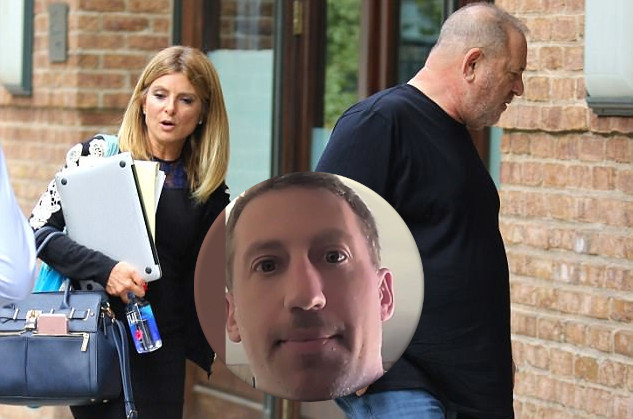
Critics point towards Lisa Bloom’s previous representation of Harvey Weinstein, alongside controversial attorney Alex Spiro, as a red flag and an obvious conflict of interest.
Spiro’s client, Shawn Carter, AKA Jay-Z, was a close associate with Sean Combs for decades, and both were accused of raping a 13 year-old-girl in 2000. Carter recently lost an appeal in a related case. Spiro was accused of obtaining evidence from a Weinstein victim, using “deceptive tactics.” Weinstein has also been heavily linked to Shawn Carter, including in an FBI report alleging rape (a separate alleged rape case, not the same one as the 13 year-old-girl). Gloria Allred’s daughter, was also the director of Diddy: The Making of a Bad Boy, a documentary that Combs sued over and lost.
What Remains
Sapp may refile the city-law claim in New York state court. Federal law pauses the limitations clock while a claim is in federal court and for 30 days after dismissal.
The analysis described the possibility of refiling the sexual assault claims in Nevada or California as an open and contested question of preclusion law.
The original complaint was filed about four weeks before the city-law revival window closed. That deadline offers one explanation for the choice of a New York court. The analysis found that choice ultimately cost Sapp the two claims the court accepted were timely under California and Nevada law.
Editor’s note: This article was produced by an AI system based solely on its analysis of three court filings: the original complaint, the amended complaint and the judge’s opinion. It includes no interviews. Several legal authorities cited in the opinion were issued after the AI’s training data ends and were not independently verified. The allegations against Combs in this lawsuit have not been proven. This is commentary, not legal advice.
This is an opinion article.