

NEW YORK — Tony Buzbee’s lawyers told a federal judge Friday that the sworn declaration Shawn Carter obtained from the woman who once accused him of raping her at 13 is a “bought-and-paid-for Declaration,” obtained “in exchange for dismissing her,” and that Carter’s own lawyers know it is “probably false and perjurious.”
The letter, filed Sept. 25 by Sheppard Mullin partner Jessica Meyers in Carter’s malicious-prosecution suit before U.S. District Judge Dale E. Ho, asks the court to strike the declaration as “immaterial, impertinent, or scandalous.” Carter, it notes, “was not required to file the Declaration along with the Notice of Dismissal, and filing the Declaration seems to serve no purpose other than to harass and impugn the Buzbee Parties.”
It was the second letter Meyers sent Judge Ho that day. The first accused Carter’s lawyers of deceiving her and the court.
Did Carter Tamper With The Victim?
The heart of the strike motion is a request for judicial notice. Jane Doe, Meyers wrote, signed two declarations under penalty of perjury, on Nov. 18 and Dec. 8, 2024, “confirming under penalty of perjury the truth of her allegations against Carter.” She then filed more sworn declarations in Carter’s California suit against Buzbee, “standing by her claims.” Carter’s lawyers have had all of them since March 2025. Now they have filed a third version, signed Sept. 24 in Mobile, Alabama, in which she swears Carter “never raped me” and that she has “never met or spoken to” him.
Carter’s team, Meyers wrote, is “advancing testimony that they either (1) know is probably false and perjurious, or, at best, (2) know is offered by a witness (Jane Doe) that they have spent two years calling inherently unreliable, and who has repeatedly offered sworn testimony that is directly contrary to the testimony they secured by dismissing her.”
Then she quoted Carter’s complaints back at him. His original complaint said “a simple Google or other public record search” would have shown Doe “had been in court on mental health related issues in connection with her second degree assault charge, and had her bail revoked for failing a drug test,” that “she has several mental health disorders, and takes multiple medications.”
Carter’s operative Third Amended Complaint still calls her “an unreliable witness” and cites “concerns about her credibility.” “In sum,” Meyers concluded, “there is no evidence that when the Buzbee Parties relied on Jane Doe’s multiple declarations they knew her to be a perjurer. Carter and his attorneys lack the same excuse.”
“Procured By Fraud” and “Bait-and-Switch”
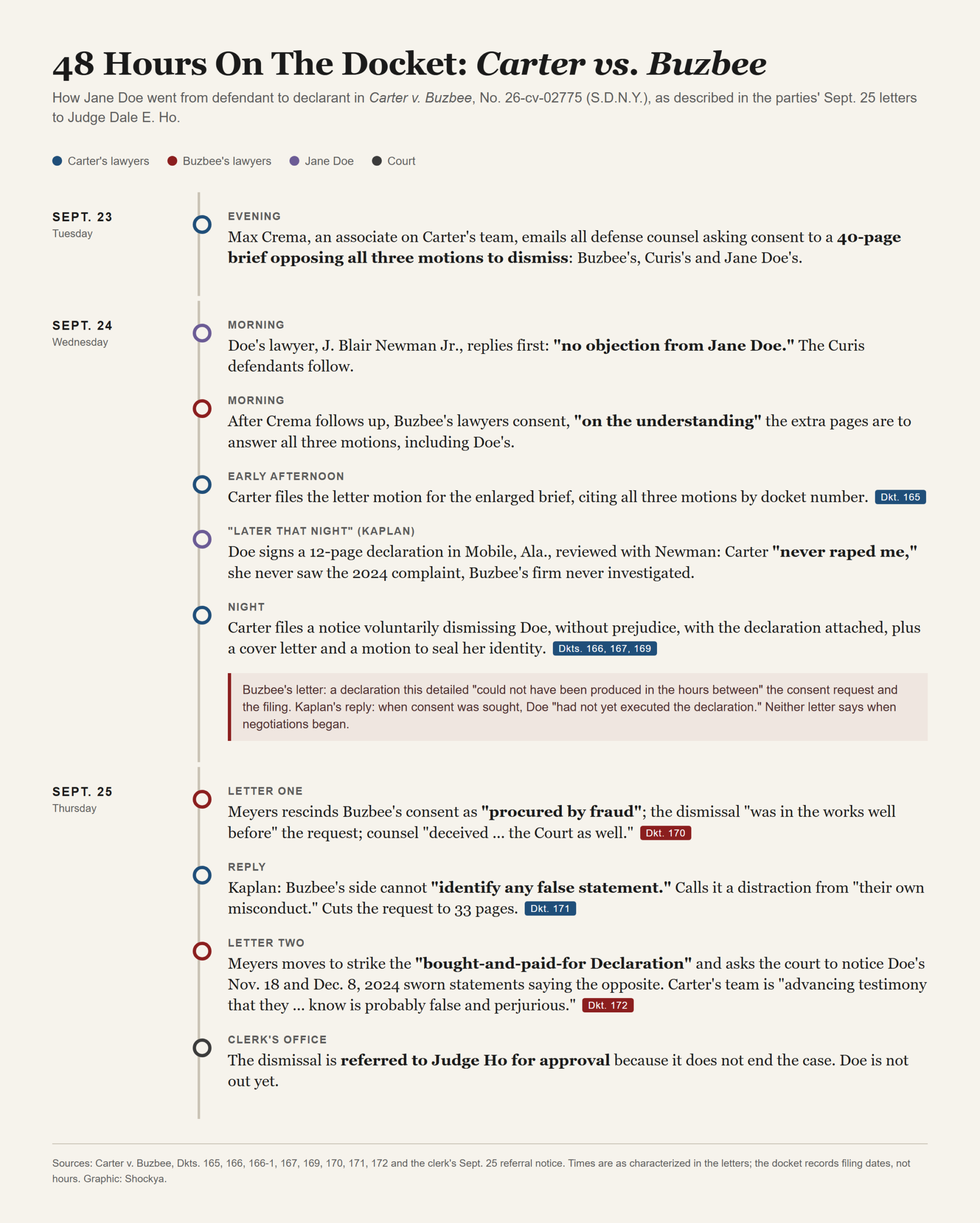
Meyers’ first letter laid out the timeline. On the evening of Sept. 23, Max Crema, an associate on Carter’s team, emailed every defense lawyer asking for consent to a 40-page brief opposing all three pending motions to dismiss, including Doe’s. Doe’s lawyer answered first the next morning: “no objection from Jane Doe.” Buzbee’s side agreed “on the understanding that Plaintiff was seeking an extra fifteen pages to respond to all three of defendants’ pending motions.” Carter’s letter to the judge cited all three motions by docket number. Hours later, Carter dismissed Doe and filed her 12-page declaration, which says she reviewed it with her lawyer, J. Blair Newman Jr., before signing.
Carter “should not be rewarded for his and his counsel’s dishonest conduct.”
“The only reasonable conclusion to be drawn,” Meyers wrote, “is that the dismissal of Jane Doe from this action … was in the works well before Plaintiff’s counsel requested leave.” Carter’s lawyers “not only deceived counsel for the Buzbee Parties and Curis Defendants, but the Court as well.” She rescinded the consent as “procured by fraud,” called the sequence a “bait-and-switch,” and said Carter “should not be rewarded for his and his counsel’s dishonest conduct.”
“Perjurious” – Fraud Alleged
Roberta Kaplan replied the same afternoon to the first letter, and only the first. “It is telling that the Buzbee Defendants do not—because they cannot—identify any false statement made by Plaintiff’s counsel,” she wrote. The page request went out “in the early afternoon of September 24,” when Doe “remained a defendant, her motion remained pending, and she had not yet executed the declaration filed later that night.” Buzbee’s theory, she said, “depends on treating a later development as though it had already occurred.”
Read it twice. Kaplan does not say the declaration was not in the works. She says it was not signed. Meyers did not accuse anyone of a false statement. She accused them of asking for consent while sitting on what they were about to file. A 12-page sworn statement with a privilege waiver and a lawyer’s review does not come together between lunch and midnight, and Kaplan does not claim it did. Doe’s own lawyer said “no objection” that morning to a brief opposing his own client’s motion, which he presumably knew was about to become moot. Kaplan called the fraud accusation an attempt “to distract attention from their own misconduct by manufacturing a dispute about page limits,” cut her request from 40 pages to 33, and asked the judge to leave Crema out of it. As of Friday night, she had not answered the strike motion or the word “perjurious.”
The Dismissal Isn’t Done
One more line on the docket matters. On Sept. 25 the clerk’s office flagged Carter’s notice of dismissal and “referred [it] to Judge Dale E. Ho for approval” because it “did not dismiss all of the parties or the action in its entirety.” Doe is not out yet. The judge who decides whether she leaves is the same judge Buzbee’s lawyers have just told that the document she left with was purchased with the dismissal itself, and that the man who filed it spent two years calling her a liar.
“They Told Me Jay-Z Was Threatening to Kill Me.”
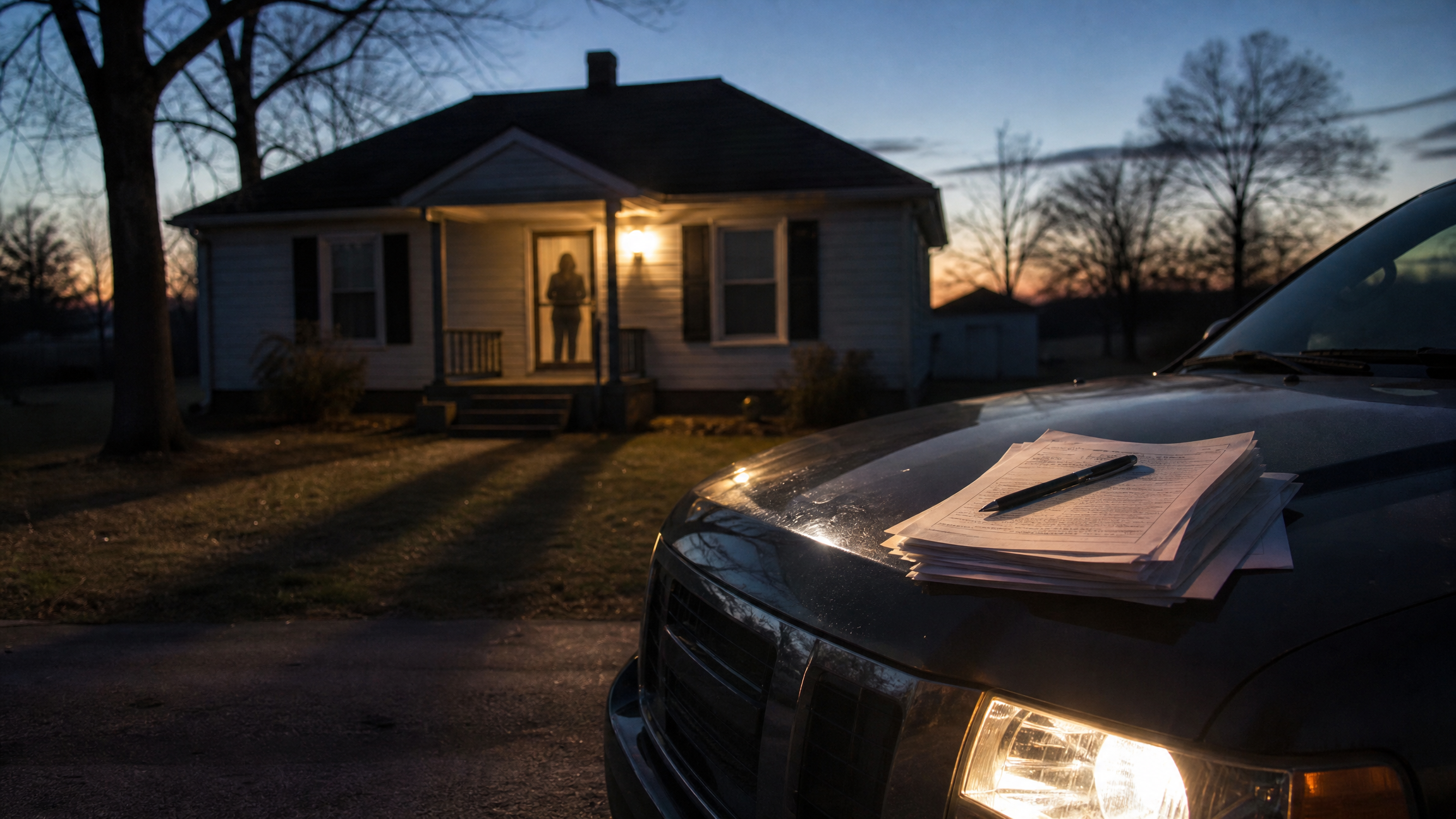
Meyers is right that Carter’s lawyers spent two years calling Doe unreliable, and that is the point. Doe’s declaration says the Facebook ad that started this “triggered memories of being raped when I was 13 years old.” She has never withdrawn that, and nobody on Carter’s side has ever asked her who did it. Buzbee’s firm took her on, flew her to Houston, covered her expenses, and stood beside her when she told her story to NBC News. When she wanted out, Fortney drove to Alabama and let her sign the dismissal from the safety of his car.
Eight days later Carter’s investigators were at her door. On a recording Carter’s investigators made outside her house, she said Fortney told her she had to dismiss the case because “they told me Jay-Z was threatening to kill me.” That line is quoted in Carter’s own complaint.
David Fortney told her “it was dangerous to speak about the case at all.” Twenty months later, Carter’s Third Amended Complaint catalogued her suicide attempt, her medications and “a history of hallucinations,” and said she “was no mere victim.” Then, once she signed, he moved to let her go.
That is what a rape victim with a documented psychiatric history looks like after two legal teams are finished with her: a child who was abused, an adult who cannot reliably say by whom, and three sworn statements that cannot all be true. We asked the question the night the declaration landed: is Jay-Z tampering with victims?
Buzbee’s lawyers have now asked it in a federal filing. Buzbee alleged in December 2024 that investigators tied to Carter were offering his clients money to sue him. Carter’s California suit against Buzbee was dismissed and the appeal failed on Sept. 9. Judge Ho has not ruled on the strike motion, the page limits, the dismissal, or the motions to dismiss.
Without Doe, Carter has no witness. With her, he has one who has sworn to both stories.
Did Jay-Z Get To Jane Doe’s New Lawyer?
Which raises a question about the lawyer who sat with her while she signed. J. Blair Newman Jr. of McDowell Knight Roedder & Sledge in Mobile is Doe’s “independent counsel,” according to the declaration, and the man who “reviewed and discussed it” with her before she put her name to it. Three weeks earlier, on Sept. 1, Newman filed a 31-page motion arguing that Doe’s prior statements were privileged and that Carter had no business suing her in New York at all.
On the morning of Sept. 24 he told Carter’s lawyers he had “no objection” to a longer brief against his own motion. That night his client signed a document that mooted the motion, waived her privilege over everything she ever said to her former lawyers and the intake call center, and carved out one exception: her communications with Newman’s firm.
Nothing in the declaration suggests he investigated her original account before she disowned it, sought out anyone who could corroborate it, or asked why a woman his client’s opponent had spent two years calling a hallucinating perjurer was suddenly a reliable witness for that opponent. Several witnesses have since come forward to support her original account, and reported no follow up by Newman.
Independent counsel is supposed to be independent of the other side. Whose interests were served by this declaration, and who was in the room when it was drafted, are questions only Newman can answer. He should be asked.
Sources: Carter v. Buzbee, No. 1:26-cv-02775-DEH (S.D.N.Y.), Dkts. 145 (July 29, 2026), 165, 166, 166-1 and 169 (Sept. 24), 170, 171 and 172 (Sept. 25), and the clerk’s Sept. 25 referral notice; Doe v. Combs, No. 1:24-cv-07975 (S.D.N.Y.); Paul Smith’s reporting at Shockya. This is an opinion article.
Related Coverage
- Is Jay-Z tampering with victims? “Something ain’t right about this”
- Jay-Z loses appeal to Tony Buzbee in “13-year-old girl” rape case
- Jay-Z’s major defeat in court while Alex Spiro traipses in Italy
- Tony Buzbee alleges investigators linked to Jay-Z and Diddy are offering to pay clients to sue him